


Accessibility Professionals
Accessible Bathrooms
Accessible Bathrooms
The ability to use the bathroom conveniently is something many of us take for granted. But for those with age-related or physical disabilities it can be hard to carry out these everyday tasks. Luckily, it’s never been easier and more affordable to renovate for accessibility, and millions of people are beginning to realize how life changing accessible bathrooms can be.
An accessible bathroom changed Mary’s life:
Mary was having difficulty using the tub and had fallen in the bathroom. Mary called her state’s Independent Living Center, who then referred her to an Occupational Therapist (OT) who was able to offer many useful ideas. The OT visited Mary at her home and made accessible recommendations that could be installed quickly and were relatively inexpensive.
Within a week, her son Mike had installed two grab bars in the bathtub and a hand-held shower for better control. Mary also purchased a simple bath-bench, so she can enter the tub safely by sitting on the bench outside the tub, sliding over, and maneuvering her legs into the tub.
Encouraged by her newfound independence from her accessible improvements, Mary continued to look at other accessible bathing solutions and within two months had installed a roll-in accessible shower to replace her bathtub. Now Mary enjoys bathing in her barrier-free shower, safely and independently.
Before making her bathroom accessible Mary, like many her age, feared falling in the bathtub. Today, Mary thoroughly enjoys her bathing experience.

ADA Compliant Accessible Bathroom
For commercial applications the American Disabilities Act (ADA) and Accessibility Guidelines for Buildings and Facilities (ADAAG), cover the construction and alteration of both private and public sector facilities. For more detailed information on these commercial applications, visit ADA Showers.
Also, please be aware that state regulations may exist and be enforced in your area for multi-family housing developments.
Residential Accessible Roll in Showers
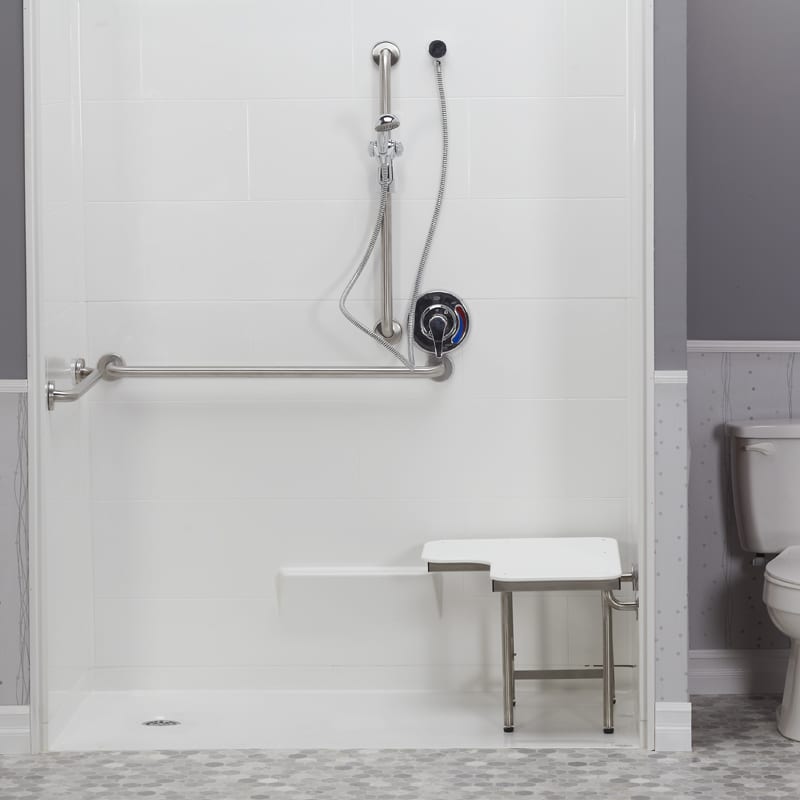
Accessible showers are found in homes across the country. And they aren’t just for those with physical limitations, as roll-in showers come in a variety of designer styles.
- Roll-in showers make it possible for a person with a disability to wheel into the curb-less shower. They can then transfer, with or without assistance, to a wall-mounted shower chair.
- Alternatively, the user can transfer to a shower chair then roll into the shower stall with assistance.
- Accessible bathtub replacement shower models have a 60″ outside dimension as they are designed to utilize the bathroom framing around conventional 5-foot tubs.
- Prefabricated accessible roll in showers are constructed of fiberglass, with reinforced walls and an applied acrylic finish.
Shower Pans
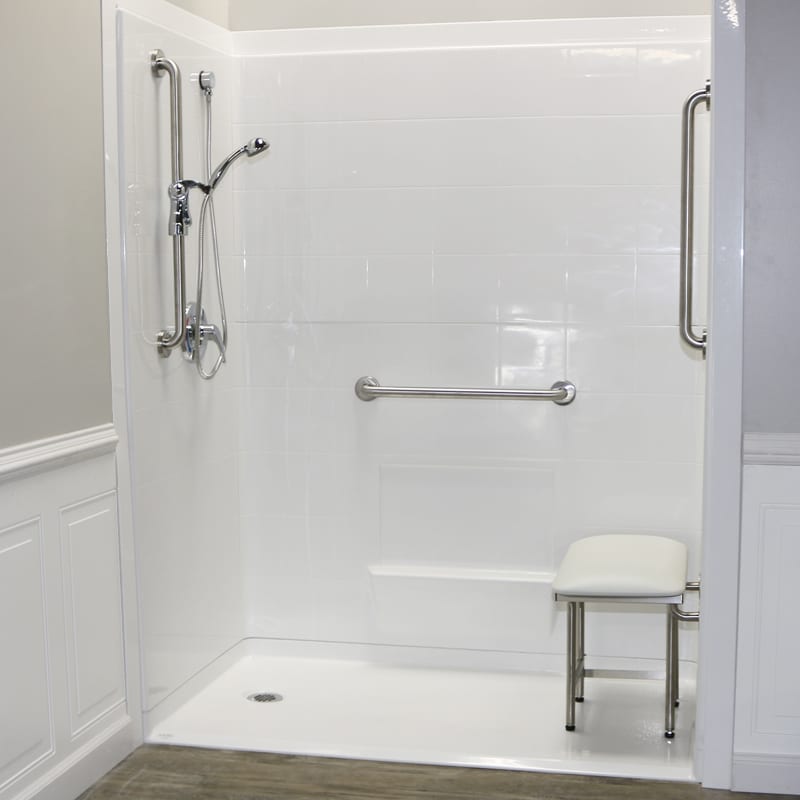
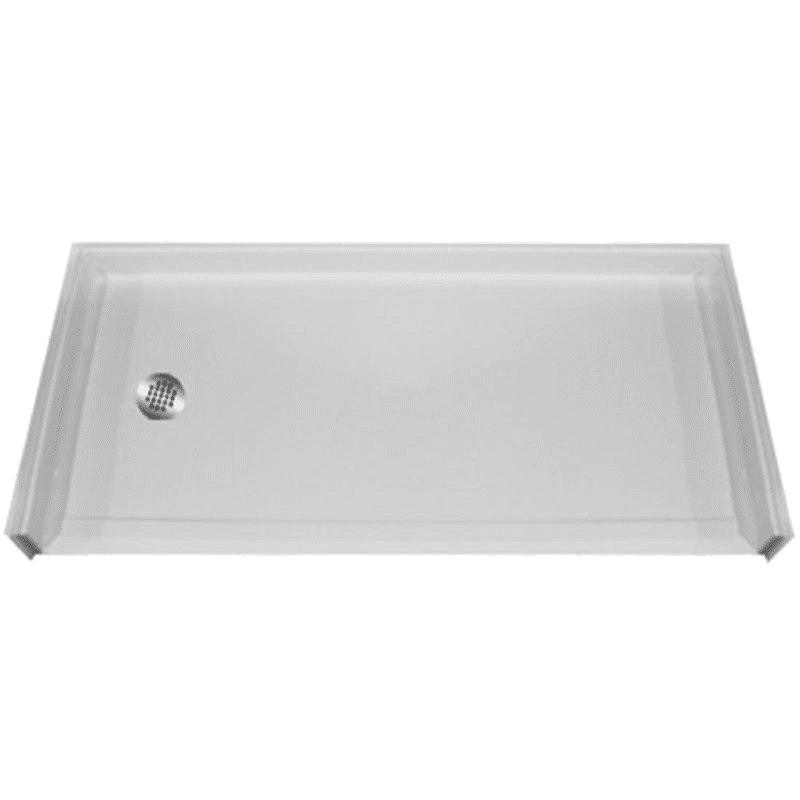
An accessible barrier-free shower pan can be combined with ceramic tile walls for a beautiful custom designed shower that will accommodate anyone, even if they use a wheelchair or walker. Visit Freedom Showers to view view all Accessible, ADA and Easy step shower pans, as well as tiling options.
See ADA and Accessible Shower Pans
Bathroom Safety Grab Bars
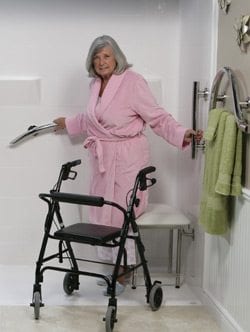
Grab bars are a great way to reduce falls and provide support in accessible bathrooms. Here are some tips on grab bar installation:
- Install grab bars next to the toilet and in bathing areas.
- Wall-mounted grab bars should be 1-1/4″ to 1-1/2″ in diameter. The space between the grab bar and wall should be 1-1/2″ to allow a firm grip.
- Grab bars should also be placed inside bathtub and shower enclosures to avoid slips.
- If you are remodelling or building new and the walls are open, be sure to provide wood blocking in the walls for reinforcement of the grab bars.
Walk-in Bath Tubs
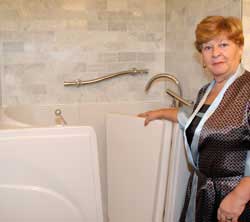
Walk-in tubs have become an incredibly popular solution to the high-step conventional bathtub.
These “sit up style” bathtubs offer people a low 4-6 inch step instead of the high step found in standard tubs.
Walk-in tubs are a great option for those who enjoy rehab at home with water or air jets. A walk-in tub can create a personal therapeutic spa at home.
Visit Freedom Bathtubs for a wide selection of bathing solutions.
Doorway Widening and Improvements
Standard interior residential doors are usually 30″ wide, but wheelchair users need wider doorways to pass through comfortably.
- In order to accommodate a wheelchair, which is 24-27″ wide, doorways should be a minimum of 32″ wide.
- If a wheelchair user needs to turn to get into the bathroom, you’ll need a 36″ door, to allow access.
- A narrower width may be adequate if the bathroom door allows a straight wheelchair approach. Using offset door hinges can be a more affordable way to increase door widths by about 2″, which is often enough additional width for a wheelchair or walker to pass through the doorway.
- If possible, there should be no threshold in the doorway. If this can’t be avoided, select a flat threshold that is no more than ¼ inch high, or one that is beveled on both sides and no greater than a ½ inch high.
- Install easy-to-grasp lever door handles on all doors for additional accessibility.
Doorway Widening and Improvements
Non-slip Surfaces
Bathroom floors can be incredibly slippery, especially when wet, and are the reason for countless emergency room visits. Reducing the slipperiness of the bathroom floor is often an easy and inexpensive modification:
- Use non-slip flooring and bathing surfaces.
- Many accessible showers and bathtubs come with slip resistant surfaces.
- Sheet vinyl flooring is also a good choice, since it is smooth and easy to clean.
- Apply a non-slip coating in showers or bathtubs.
Accessible Toilets
Different users have different needs, so take the time to determine which modifications would be the most appropriate in your accessible bathroom design.
Toilet heights are described as low or high seats.
- High toilet seats are 17″ to 19″ above the finished floor, compared to standard seats at 14″ or 15″. This reduces the need for lowering and lifting oneself on and off the seat.
- High seats are ideal for ambulatory bathroom users who have difficulty getting to their feet from a sitting position.
- A high seat is often not appropriate for an unassisted wheelchair user or people of shorter stature.
- Check with ANSI and UFAS Standards to determine the amount of clearance room you need around the toilet, which will depend on the approach to the toilet. For example, you will need about:
- 5′ x 4’8″ for a front or side approach with no lavatory (sink) next to toilet.
- 4′ x 5’6″ for a front or side approach with lavatory next to toilet.
- 4′ x 4’8″ for a side approach with lavatory next to toilet.
Roll-under Sinks and Vanities
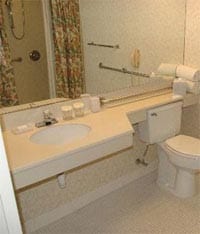
Bathrooms are more accessible to wheelchairs if a pedestal wall-mounted sink or vanity is installed.
- A portion of the clear floor space located under the fixtures provides the required knee and toe clearance so that a wheelchair can be rolled up to the bathroom sink.
- A recommended 34″ space from the top of the counter to the floor, and 29″ from the underside of the sink to the floor is best for wheelchair users.
- Insulate hot water pipes under the sink, to prevent injuries.
- A panel could also be used under the sink to hide the plumbing and provide protection from the pipes.
- Make the sink height adjustable with a sink or counter lift.
Mirrors, Cabinets, and Counters
Bathroom floors can be incredibly slippery, especially when wet, and are the reason for countless emergency room visits. Reducing the slipperiness of the bathroom floor is often an easy and inexpensive modification:
- Wheelchair users need low mirrors. A tilt-down mirror can be adjusted as needed by all family members.
- Prescription medicine can be stored in an accessible wall cabinet with shallow shelving.
- Shelves should be near eye level so small print on the labels can be easily read. For wheelchair users, a wing wall beside the vanity is an excellent medicine cabinet location.
Bathroom Lighting and Electrical
- Accessible bathrooms should be well lit with artificial and natural light.
- A casement window is easiest to open and close for those with limited dexterity.
- Vanity lighting for wheelchair users may require minor adjustments. Most wheelchair users, for example, cannot get close enough to the wall mirror for focused activities such as shaving or applying make-up.
- A portable self-illuminated mirror kept within reach is often helpful.
- Light and fan switches should be installed in accessible locations away from water sources.
- Electrical outlets should also be installed in accessible locations to serve bathroom appliances such as hair dryers and razors.
- Radiant ceiling lamps are an inexpensive and effective option for helping to stay warm when wet.
- Shower interiors are often dark when the curtains are closed, so a waterproof light fixture is recommended inside stalls and above tub/shower enclosures.
There are many ways to make your bathroom safer and user friendly for the whole family.
Remember, if you have any questions at all, our expert customer service team is here to educate you on the high-quality, customizable options in handicapped accessible bathrooms.
An accessible bathroom can change your life and Accessibility Professionals is here to help.
Making Independence a Reality | Freedom Showers™
Please don’t hesitate to call us at 1-877-947-7769
Save Up To 38% on Select Showers
Visit FreedomShowers.com for details and pricing.

Call 1-877-947-7769
Call now to speak with a customer service expert.
Or See More at FreedomShowers.com